Monday, July 20, 2020

Teaching as Inquiry: Through a coaching lens Seession 1
Why is this important?
Reflective
Demonstrate you as a leaner
Agency as adult learners
Participator vs contribute
Need to build relationships
practise may be challenged and some may take it personally so how do we manage this as
How will we know that TAI is working well in your school?
Time
Valuing authentic evidence
Happy on task students and teachers motivated
As a leader operate at many levels:
Team TAI
Personal TAI - need alignment and line up to strategic plan
Need to value it so where is the time necessary for this
Need systems and processes put in place for this to occur
How we value evidence? What is it and how do we value it? CHOICE
To keep it fresh could do the following approach
Learning sprint approach ( Simon Breakspear)
twice a term? Or TAI a term
Questions are hyper focused.
Team approach collaborative approach rather than writers This approach can be a fail fast and a fast forward approach.
Lightbulb moment aligned both TAI's with collaborative teaching and
Team to make up a narrative whether it be a recording of th einquiry cycle
4 pronged approach to coaching: Coachin Mode
Awareness slide 13
Photo of what was shared of not what to do. Awareness is a step forward.

How do I coach?
What questions are to be asked to help my teachers feel challenged?
AN example problem of practise. Practical exercise
Coach is listening can paraphrase or clarify.
Giving them the space people can come to the answer themselves if you can give them time to talk by above ideas.
Listen well if in the role of paraphrasing. When present with someone in an authentic way a personal way genuine and helps them come up with the solution themselves.
Who do I need to be as a coach in the particular conversation?
Slide 26:
Coaching
What is the evidence & How can we collate it? When looking at TAI and team Observations.
Take a video of the teacher and give them time to look at the video footage so they make their own decisions.
- Evidence could be student voice:
- Keep it real and give it deep questions so get what you need depending on hunch?
- Swivel. Could use student leaders to gather evidence.
- Student work
- Achievement data
- modelling books/planning
- video from their phone or ipad - tell me what you noticed to what your goal was?
VIDEO of what is going on in the background - video of practise then video the coaching conversation then could have a video of yourself as a coach to see how you went.
Agreed purpose and
 |
| Used in the past for a good SMART goal. |
Resources shared through slide
Coaching template etc
Next steps: Discussed at the PLD
What do we need to lean into as our school TAI?
TIME:
Alignment with TAIs is a must;
What are the nonnegotiable from Principal and leadership about how we record our evidence
Data analysis.
TAKE AWAY: Let's do this in a way that's authentic an not a tick box
Sunday, July 19, 2020
Saturday, July 18, 2020
TLIF
An investigation into student-centred reporting in the online environment
St Mary’s Catholic School, Tauranga (TLIF 1-151)
The quote below is from a learning conversation in which Carter and his teacher discussed a new piece of writing in relation to his personal learning goal. Together, they then went on to set a new learning goal. The conversation was recorded and shared on Seesaw, along with a scan of Carter’s work.
Teacher: Do you like writing, Carter?
Carter: Yes, it’s my favourite activity to do.
Teacher: Why do you think it’s important to learn how to write, Carter?
Carter: Because lots of times you have to write; like, say, if you’re writing a letter or you have to answer a question by writing. And it helps you to learn and your brain grows bigger.
Overview
Teachers at St Mary’s Catholic School were concerned that despite efforts to create a learner-centred environment, their students were not as agentic as they would have liked. Most students were unable to articulate the learning task or its context. They could not talk about their learning in relation to the success criteria or identify their next learning steps. They relied on their teachers to direct the learning. When asked, students could not describe how the use of digital devices might support their learning. The school’s data also showed that parents and whānau were interested in greater collaboration, but most did not know how to do this in the online environment and were not offered such opportunities. Teachers were unsure about how to grow student agency and how to make formative assessment and critical conversations an integral part of teaching and learning. It was apparent that everybody needed support to play their part in growing students as twenty-first-century learners.
The school had a tradition of collaborative learning and a willingness to innovate, supported by the stance that mistakes are to be expected, inspected, and respected. This project built on those strengths to facilitate learning for everybody in the school community, particularly regarding clarity. Implementing an approach to formative assessment that sees it as being both ‘as’ and ‘for’ learning empowered students with a greater sense of their agency and led to academic success. As we learn from Carter, writing became fun and felt purposeful. The use of online tools enabled connections to be created between the learning conversations students participated in at home and school.
The inquiry story
This three-year inquiry project involved approximately ten teachers of students in years 2–6. The makeup of the project lead team changed in this time, partly due to staff turnover, but also because of a decision to expand the team to include the leaders of the school’s four teaching teams. This was done to achieve greater consistency in practice across the school. The inquiry process was guided by the Spirals of Inquiry framework. Each teacher selected a focus group of five students who they identified as achieving below expectation for writing at the start of the project.
What was the focus?
The focus of this project was on enhancing student agency and raising achievement by taking a student-centred approach and engaging students, teachers, and whānau in a reciprocal learning partnership. The intention was that students would be able to talk about and share their progress in an online environment using progressions of learning and that they would be able to provide feedback about their learning to their teachers and whānau.
While the project intended that all students would benefit, there was a focus on priority learners: Māori and Pasifika students, those from low socio-economic backgrounds or who were underachieving, and those with additional learning needs. Likewise, while the team hoped to see improvement in all core curriculum areas, it focused its attention on writing.
The project’s central inquiry question was, “How do teachers, as they inquire into their own teaching practice, make an impact on student learning and assessment capability in an online environment?”
The team established two connected learning outcomes:
· Students are able to talk about their learning and find evidence of meeting the success criteria.
· Students are able to share this with teacher or peer, using the progressions to support their assessment.
What did the teachers try?
The project team theorised that if students are clear about their learning (that is, they know what they are learning and why, what they need to do next and how to get there), their attitude, achievement, and sense of agency will improve. Achieving clarity requires pedagogical practices that combine ‘assessment for learning’ with ‘assessment as learning’. While most New Zealand teachers are familiar with the former concept, the latter term may be less familiar. The Education Review Office describes assessment as learning as “the process of students monitoring their own learning and progress. It occurs when students understand how they are learning and what[KD1] they need to do to improve. They can interpret their assessment information from different sources and use it to make decisions about their own learning” (Education Review Office, March 2007). The team also theorised that the use of online tools would enable learning conversations to connect between home and school.
The innovations included the following:
· The team constructed learning progressions that made the school’s expectations for progress in writing visible to everybody in the St Mary’s School community. The progressions are now displayed throughout the school and supported by other resources, such as exemplars and rubrics. The latter are co-constructed with students in relationship to particular learning tasks.
· Writing progressions, student voice data, recorded learning conversations, and Assessment for Learning matrices are uploaded to Seesaw and shared with parents and whānau. The latter is used to monitor students’ progress in terms of their clarity of learning. The progressions have been progressively modified to make them more child-centred.
· A new report format was developed that includes spaces for student and parent reflection.
· Time for reflection is now timetabled into the day and week and underpinned by routines and processes to ensure this activity is worthwhile. Reflection involves students in making their learning goals explicit and demonstrating evidence of their progress towards achieving them. Every student has a learning buddy with whom to write their self-reflection and senior students record their reflections independently on Seesaw.
· Teacher professional learning and a ‘writing toolkit’ provide clarity about the school’s expectations for teaching writing. Shared expectations for teachers include ensuring that students always understand the purpose and audience for their writing, establishing a global learning intention when planning for writing and a specific learning intention for each lesson, and recording the learning intentions and success criteria in their modelling books.
· Across the school, teachers are expected to use the same language for talking about assessment and writing. The use of consistent terms deepens everybody’s understanding of what they mean.
· The language of assessment being ‘as’ and ‘for’ learning is being incorporated into teacher professional learning and appraisal conversations. That is, teachers are supported to gain clarity about where they are, the improvements they need to make, and how to make those improvements.
What happened as a result of this innovation?
Students
Student agency has increased significantly. The majority of students:
· see themselves as writers and enjoy writing;
· can talk about their learning with their peers and teachers;
· can describe what they can do, where they are at, and how they know this;
· understand and can describe their next steps for learning;
· use progressions, rubrics, and success criteria to support their self-assessment;
· treat mistakes as learning opportunities;
· use Seesaw to share their progress.
Whānau support was motivating for students, leading to more discussion at home and, in some case, students wanting to write more at home.
Achievement data shows accelerated improvement, for example:
· In 2016, 55 students were below the expectations then set by the National Standards in writing, and 15 were at the expected level; in 2018, this changed to[KD2] 33 below and 82 at the expected level.
· In 2016, 18 Māori and Pasifika students were below the expectations set by the National Standard in writing; in 2018, this dropped to 4.
Teachers
Teachers at St Mary’s take collective responsibility for student learning. They have developed capabilities in ‘assessment for and as learning’ practices that include:
· using a common language about learning;
· working with students to develop rubrics for tasks that link to the progressions;
· using progressions to help students to identify their learning needs;
· conducting workshops with students on how to use the progressions and how to be clear about the learning;
· shifting the locus of control to students and fostering a growth mindset;
· fostering parent contributions to their children’s learning journey, including through Seesaw and the new report format;
· using the online environment to foster partnerships with students, parents, and whānau.
The content uploaded to Seesaw is moving towards evidence of ongoing learning – learning as it happens. The recording of Carter’s learning conversation with his teacher provides an example of this. Seesaw is also used to celebrate when a child has achieved a learning goal.
Review of the writing progressions and improved teacher knowledge and understandings have led to teachers making more accurate overall teacher judgements.
Parents and whānau
More whānau understand the learning that is taking place at school and are sharing collective responsibility for that learning through Seesaw. Whānau recognise the value of collaborating in their child’s learning in real time. The recorded conversations help whānau understand what they can do to support their children’s learning at home. Parents are making more visits to the school and offering more feedback online.
What did they learn?
The team found that the innovation with the single greatest impact on student achievement occurred through students sharing learning conversations through Seesaw. Seesaw enabled whānau to celebrate their children’s progress and be part of the learning conversations with the teacher. The provision of audio recordings, progressions, images of student work, reflections, and other visuals provided parents with tools they could use to have learning conversations with their children that align with the progressions.
They also found that the students whose achievement improved the most were those:
· who were most advanced in their assessment as learning journey and had greatest clarity about their learning;
· whose whānau were most excited and engaged with their child’s learning;
· whose teachers most effectively modelled assessment for and as learning practices.
The team concluded that the opportunity and ability to talk about learning to a teacher, peer, or whānau member supports student progress in writing.
Overall, the project reinforces the importance of ensuring that that all those with a part to play in children’s learning are clear what they are learning, how, and the path they are following. This fosters learner agency and academic success. It requires an approach that combines assessment for and as learning. It also requires consistency in language, processes, and systems. The project also shows that, used thoughtfully, digital tools can help students, teachers, and whānau take collective responsibility for learning.
Inquiry team
Initially, the project was led by Janet McCarroll and Jana Benson, supported by deputy principal, Anna MacKinnon. During the project, Janet and Jana left, and Megan Akkerman took up the leadership role. The initial inquiry team was made up of Lisa Broadmoor, Gerardine Robbie, Gavin Hesqua, Janine Goldsmith, and Joanne Meehan. Membership of this group also changed in the course of the project.
The inquiry team was supported by people with expertise in a range of fields, including:
· Ruth Pepper, Te Toi Tupu, University of Waikato
· Mark Treadwell, Mark Treadwell Consultancy
· Mark Osborne, Core Education
· Dee Reid, Director, K.I.S Education Ltd
· Professor Roberta Hunter, Institute of Education, Massey University
· Professor Tony Rickards, Curtin University?
· Mary Jamieson, Te Whai Toi Tangata, Institute of Professional Learning at the University of Waikato.
For further information
If you would like to learn more about this project, please contact the project leader, Megan Akkerman at makkerman@stmarystga.school.nz
Reference list
[We’ve included the references cited in your proposal, as well as those in the final report. Please delete any that seem irrelevant.]
Absolum, M. (2006). Clarity in the classroom: Using formative assessment: Building learner focused relationships. Auckland: Hachette Livre NZ Ltd.
Absolum, M., Flockton, L., J., Hipkins, R., & Reid, I. (2009). Directions for Assessment in New Zealand. Developing students’ assessment capabilities. Retrieved from Te Kete Ipurangi: http://www.tki.org.nz/assessmrnt/research/mainpage/directions
Benson, J. (2012). An investigation into the effective use of an IT-based learning management system to support learning in a New Zealand primary school. Science and Mathematics Education Centre, Curtin University, Perth, WA
Bolstad, R. & Gilbert, J. with McDowall, S., Bull, A., Boyd, S., & Hipkins, R. (2012). Supporting future-orientated learning and teaching: A New Zealand perspective. Report prepared for the Ministry of Education. Wellington: New Zealand Council for Educational Research. Retrieved from http://www.educationcounts.govt.nz/publications
Bull, A. & Gilbert J. (2012). Swimming out of our depth: Leading learning in 21st century schools. Wellington: New Zealand Council for Educational Research.
Clarke, S. (2001). Unlocking formative assessment: Practical strategies for enhancing pupils’ learning in the primary classroom. London: Hodder Education.
Clarke, S. (2008). Active learning through formative assessment. London: Hodder Education.
Education Review Office. (2007). The collection and use of assessment information in schools. Wellington: Education Review Office. [Our addition – only if you want it.]
Gadd, M. (2014). What is critical in the effective teaching of writing? A study of the classroom practice of some year 5 to 8 teachers in the New Zealand context. Unpublished doctoral thesis, University of Auckland.
Hattie, J. (2009). Visible learning: A synthesis of 800+ meta-analyses on achievement. Abingdon: Routledge.
McCarroll, J. (2014). An investigation into a student-centered approach to assessment and self-reporting using e-Portfolios. Science and Mathematics Education Centre, Curtin University, Perth, WA.
McCarroll, J., Benson, J. & Vincent, S. (2010). Implementing a parent portal (SMS-LMSv2) lessons learnt at St Mary’s Catholic School, Tauranga. San Francisco: Creative Commons.
Ministry of Education. (2006). Enabling the 21st century learner: An e-Learning action plan for schools 2006–2010. Wellington: Learning Media Limited.
Ministry of Education (2011). Position Paper: Assessment (Schooling Sector) Ko te Whārangi Takotoranga Ārunga, Ā te Tāhuhu o te Mātauranga, te Matekitenga, 24 September 2010.
Timperley, H., Kaser, L., & Halbert, J. (2014). A framework for transforming learning in schools: Innovation and the spiral of inquiry. Centre for Strategic Education, Seminar Series Paper No. 234.
Formative assessment in the classroom and school. UNESCO IIEP Learning Portal. https://learningportal.iiep.unesco.org/en/issue-briefs/improve-learning/schools-and-classrooms/formative-assessment-in-the-classroom-and
What is assessment for learning? http://assessment.tki.org.nz/Assessment-for-learning/Underlying-principles-of-assessment-for-learning/What-is-assessment-for-learning
[KD1]https://www.ero.govt.nz/publications/the-collection-and-use-of-assessment-information-in-schools/introduction/
How would you feel about our incorporating this definition? Could stick with the UNESCO one, but I couldn’t actually find it on the page.
[KD2]Please check that we have these figures correct. The graph and text don’t seem to quite align, but that could just be us. 😊
Tuesday, July 7, 2020
Spelling is Telling 3


Transference of spelling into daily writing tasks.
The little yellow chicken video, good to see transference example
Tips on syllable work

Important to put this in classroom

consonant gaurd traps it so short sound
Nessie clips on you tube reliable ones to view
Syllable division

I

Above strategy for syllable division
first step identify vowel and consonants. remember every syllable has a vowel in it. this word has 2 vowels so 2 syllable . first syllable has a consonant guard so short vowel say it. 2nd syllable doesn't so say c o co

consonant guard so first syllable short last not so say name
1 closed and 1 open

syllable break after the vowel so long vowel as not a guard.
so 2 open syllables

don't teach different syllable types in one session
Where to start.
Make sure have knowledge before you begin
Diagnostic sheet with sentences and student have the recording sheet

Stage 2 assessment is what I have.
Looking at letter formation as well - if reversals etc it is marked wrong. They know the sound need to work on formation
Handwriting70% of cognitive load
IF 80% doing well but still need to teach
10 or less words correct what don't they know do they have the phonological awareness intact
Dysgraphic students - firm pencil press, large writing and spelling random. Needs kids need automaticity.
Make sure you say the word as we say it usually e.g over "ova" tripped "Trippt"
So after the test.
Then Page 14 of workbook


t ed need to know that ed has a t sound but not applying

nail
long vowel sound followed by one consonant
beans

This is an order of scope and sequence. If you see there is a trend then this is where you start.
Example of an assessment. Pink is progress made. Auto data tool for classrooms

Reassess every 20 weeks
10 weeks if tricky kids. but if resourced

Where do I start teaching?
Pitch the learning at right place. Vocab cognitive ability etc
Starting point then go in scope and sequence in the order from there. Follow through systematic and accumulative teaching sequence.
Scope and sequence crucial
S

IN workbook
Best to teach in a group to build knowledge


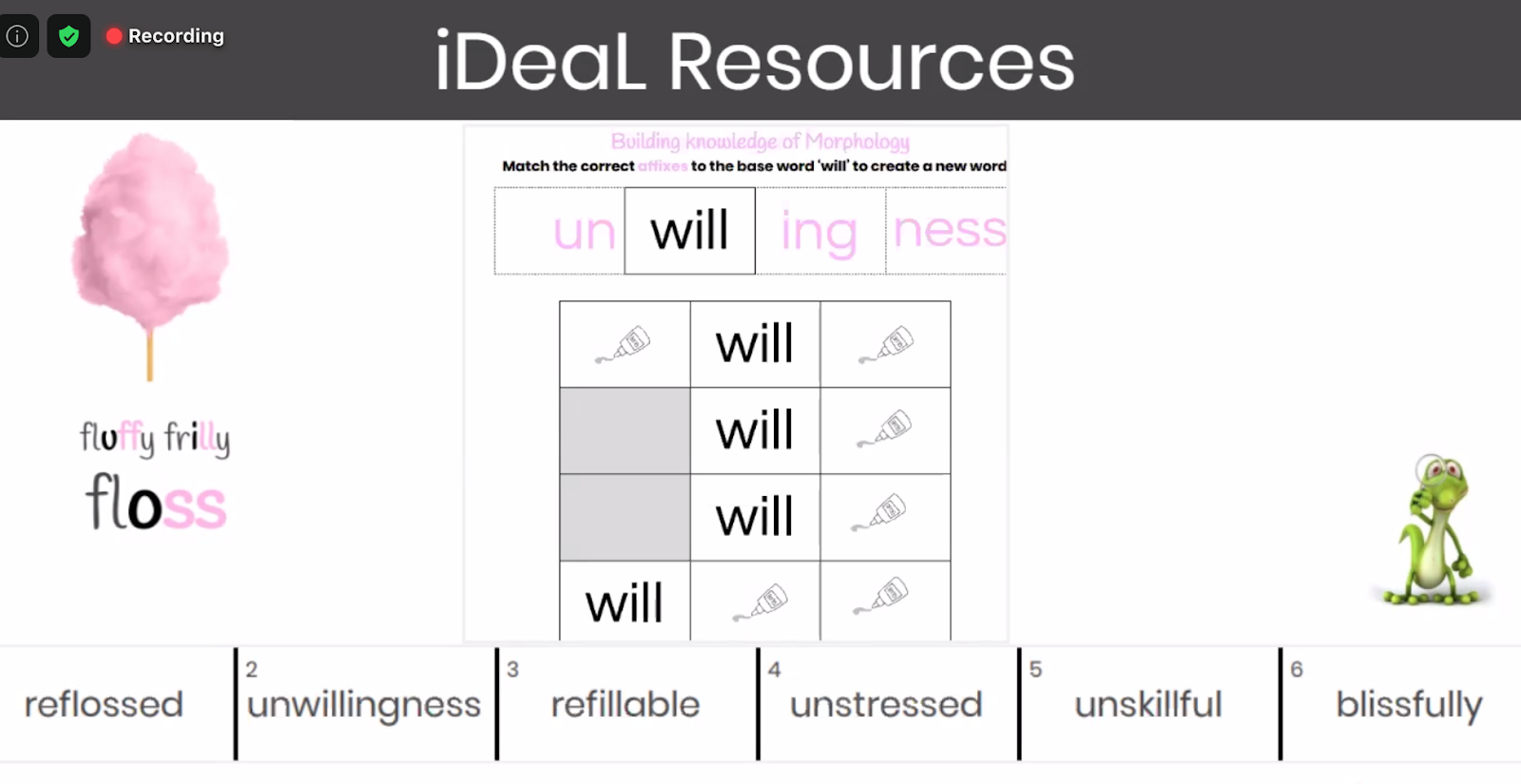


Monday, July 6, 2020
Spelling is Telling: Session 2
This webinar is an introduction to building a whole school consistent approach in spelling.
As teachers it is important we know why and what to look for so we can directly teach. Do you give words or do you teach spelling? During this series, you will learn why spelling (alphabetic principle) is fundamental to success in literacy. We will share examples of what a systematic and cumulative approach in spelling looks like.
Throughout the series you will:
* Learn many spelling rules and concepts
* Understand the difference between phonology, high
frequency words, irregular words and sight words
* Understand why having a consistent approach to the
teaching of spelling is not only important but necessary
* Develop an awareness of why some programmes seem to
work and others don’t
* Determine what your next learning steps are
* Become prepared to walk back into school the next day with
many more answers around what an evidence-based
approach to spelling looks like
* Gather the tools and develop the necessary confidence to
begin to truly teach spelling and make a bigger difference to
every student but particularly those neurodiverse learners
in your classroom
The webinar series runs over two consecutive mornings. Both must be attended to complete this short course.
Notes from:
Teach spelling with reading. What we encode we decode and visa versa. Need to transfer into daily writing tasks


Notes from:
Teach spelling with reading. What we encode we decode and visa versa. Need to transfer into daily writing tasks

Dr Louisa Moats
Takeaway from video see last post:
Speech sounds;
voiced - m, v
unvoiced - f, t
Importance of VOWELS

A LOT OF KIWI KIDS KNOW MAORI VOWEL SOUNDS NOT ENGLISH

Explicit direct instruction and practise for kids
Kids have to hold 7 sounds to learn so need to break into parts and make achievable for the learner.
Syllable say then kids repeat
isolate sounds in fist syllable you say they repeat then write it down repeat for each syllable this breaks into 3.
Great for spelling tricky words scientific words

quick. I hear short i so use ck
clock. I hear short o so add ck
When the n is in the way just use the k e.g.wink
Winnie the Witch


I hear the e followed by the tch sound.

when add a vowel suffix these all have a vowel at the beginning to a word ending
Base words and suffixes. e.g. create to creation
calculate - calculation
Syllable division how to teach unrecognisable words.
Sunday, July 5, 2020
Spelling is Telling
Important to use the 'teachable moments' in their own writing rather than worksheets.
Spelling knowledge is closely associated with reading comprehension, word knowledge and better writing.
Kids if taught from kindergarten on will benefit from explicit teaching of spelling and be better writers. Best also studies have found that the kids who have been taught to spell the high frequency words accuracy instead of inventing them are better writers.
Teach children straight away the most common spelling patterns in the language. Inventive spelling is a diagnostic tool. So being able to use knowledge of phonemic awareness by half way through structured teaching (NZ 5 half?) kids shouldn't have. a problem.
- Kids who can form letters because they've been taught
- can identify speech sounds because they've been taught will be the best writers because they have automatic mastery of basic foundations.
HOW?
Not left to chance and not as they are doing their own writing. It is from a series of structured lessons. A balanced approach such as:
Phoneme grapheme
Word origin
Word meaning
Master high frequency words (important in early years as very hard to undo invented spelling patterns if this was allowed to happen)
Key take away:
We don't use our visual memory to became a speller/

Key take away:
We don't use our visual memory to became a speller/

Practice makes permanent so important not to ignore inventive spelling and teach the correct spelling
Subscribe to:
Comments (Atom)
-
Link to article I think key is the quote " also are manageable for teachers, and ultimately reduce teacher load, not increase it....
-
 Recorded session Kylie Mckay - consultant assessor specialist educator What is Playbased learning Look at the research - How and Why...
